Hospital quality management software (QMS)
EaseQMS runs quality management as AI-assisted workflows — incidents, CAPA, drills, quality indicators, SOP control and committee meetings — connected to daily operations. The documentation NABH and JCI require builds itself as your team works.
EaseQMS automates hospital quality management end to end — incident reporting, CAPA, infection control drills, quality KPIs, SOP control, and committee minutes. Staff log in the app; documentation writes itself. Hospitals stay continuously NABH and JCI compliant.
What EaseQMS does
EaseQMS runs quality management as AI-assisted workflows, not paperwork — drills, incident reporting with RCA and CAPA, quality indicators, SOP and document control with AI search and versioning, and committee meetings, all connected to daily operations. The documentation NABH and JCI ask for is generated automatically, and your team spends less time maintaining it.
Quality management built on paper and memory
In most hospitals, the quality management system is a collection of good intentions held together with manual effort. SOPs exist — somewhere. They are stored in a shared folder, printed and filed in a binder, or emailed to the department head at the start of the year. When a nurse needs to check a procedure before an unfamiliar task, she asks a colleague. The SOP on the shared drive may or may not be the current version.
Incidents are underreported because the reporting process is burdensome. Finding the right form, filling in the required fields, routing it to the right person, waiting for someone to close the loop on the CAPA — each step requires effort that staff do not have during a busy shift. So incidents get verbal mentions, or they get reported when an assessor is coming, or they do not get reported at all. The hospital's incident data reflects its reporting culture, not its incident rate.
Quality indicators are gathered at month end. Someone is responsible for pulling the numbers from nursing records, operation theatre logs and pharmacy systems, compiling them into a spreadsheet, and sending the report. The numbers reflect what was recorded, and what was recorded reflects what staff had time to write down. Threshold breaches that should have triggered an alert in week two are not visible until week four.
CAPA actions from the previous assessment cycle are tracked in a spreadsheet, or tracked by one person who has moved on. Committee meetings happen, minutes get written, action items get noted — and then the minutes live in a folder and the action items are forgotten until the next meeting.
None of this is unusual. It is the standard state of hospital quality management when the QMS is built on paper and manual effort. EaseQMS is built to replace that with workflows that run and document themselves.
EaseQMS — quality management that runs itself
EaseQMS replaces the manual layer of hospital quality management with structured digital workflows. Each module connects to the others, and to daily operations, so quality management is a natural output of the work rather than a separate system to maintain.
Incident management
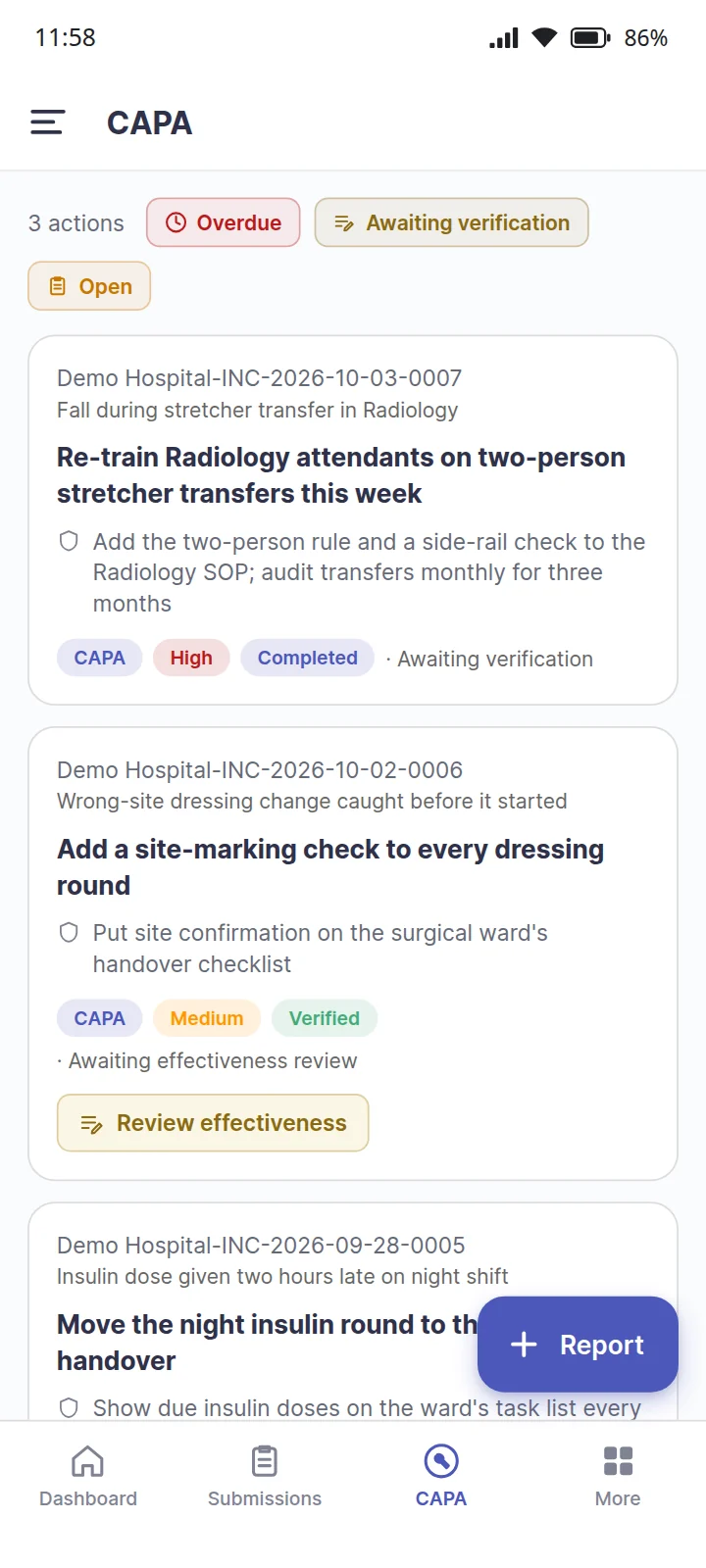
Staff raise incidents by scanning the QR poster on the ward wall, without a login, or in the app. AccredAI suggests root cause categories and CAPA actions based on incident type and historical patterns. The full trail from report to CAPA closure is tracked automatically — no follow-up required to keep it moving.
Mock drills
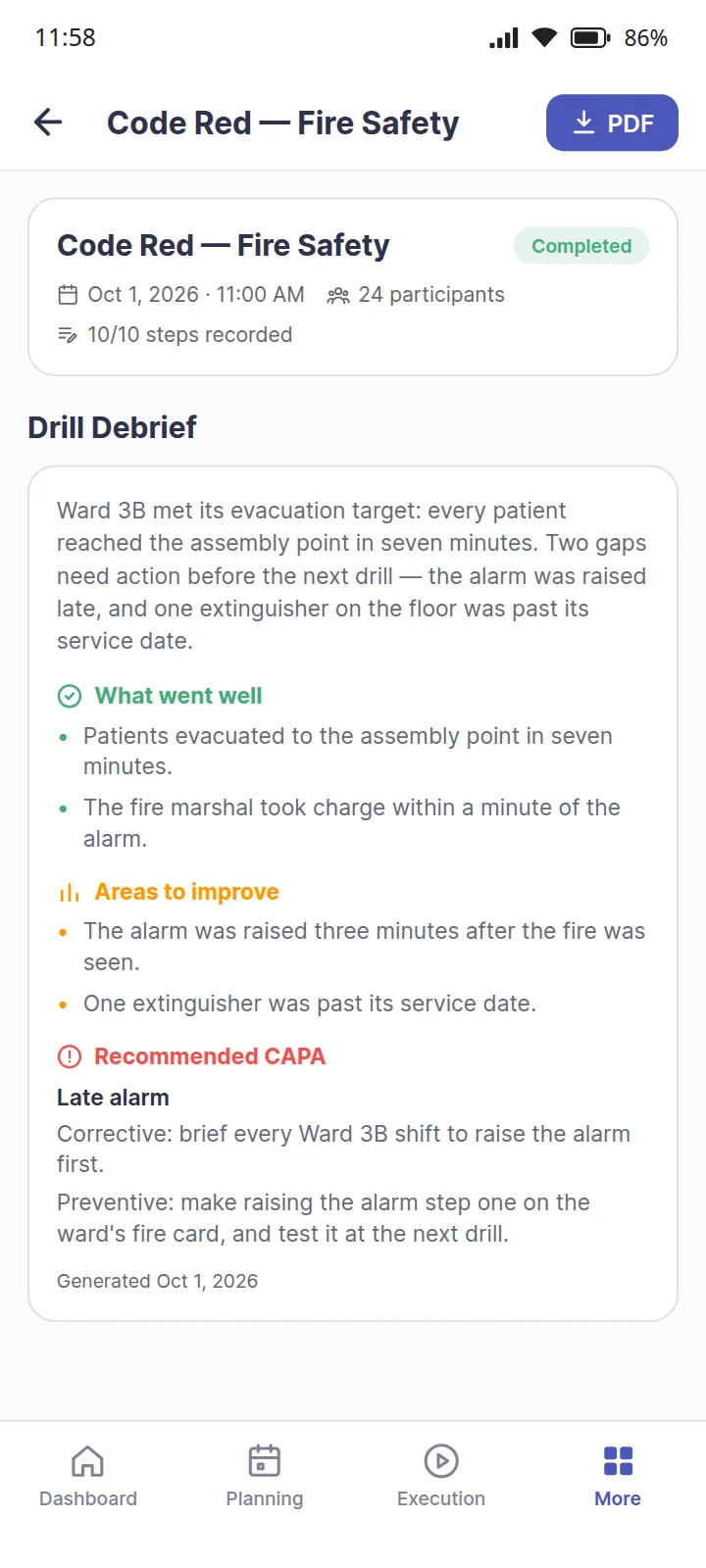
Drills are scheduled and executed through the platform. Attendance, observations, corrective actions and follow-up deadlines are all recorded in one place with a complete evidence trail available for assessor review at any time.
Quality indicators
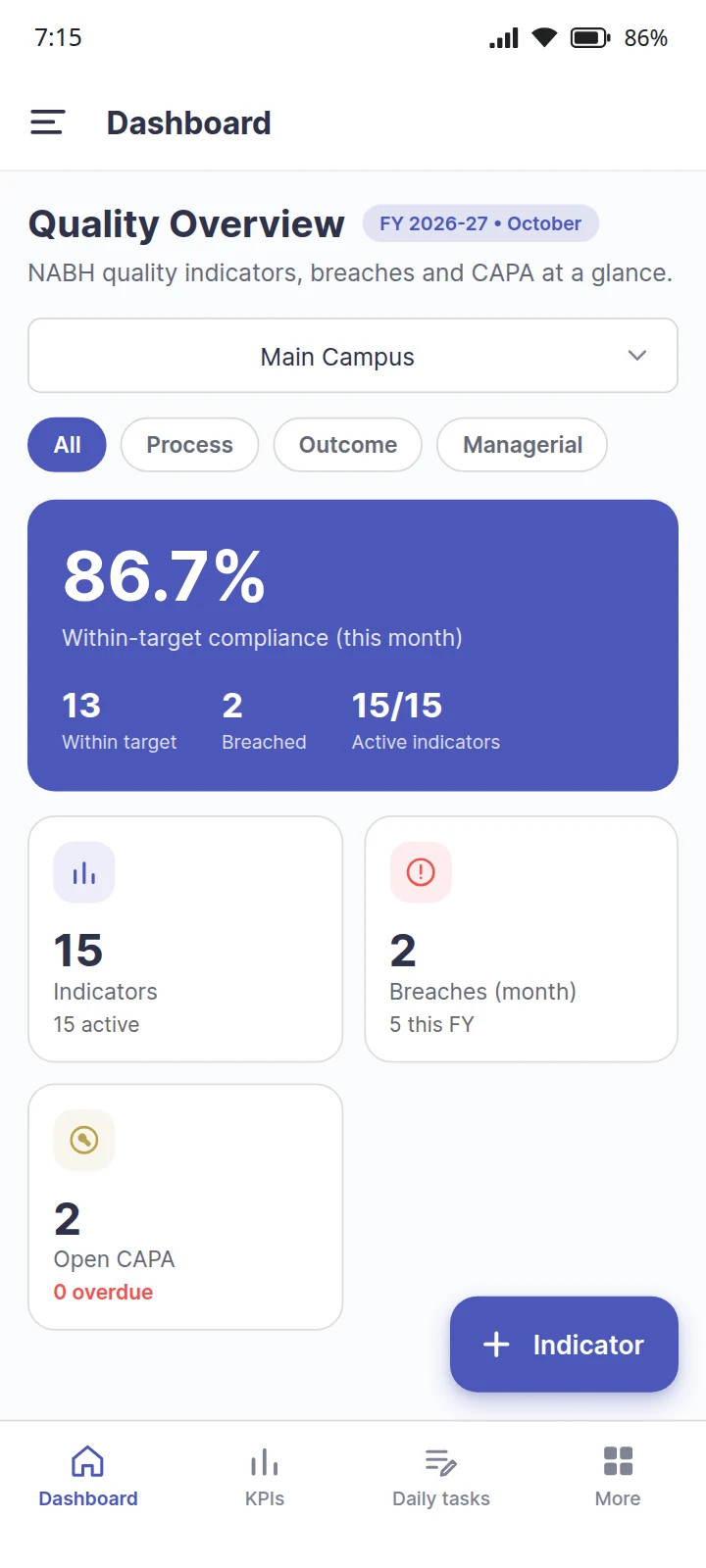
Data is captured at the point of operation, not compiled at month end. Indicators are auto-trended. Threshold alerts notify quality heads immediately when a metric drifts, so problems are visible in time to act on them.
Document and SOP control
All SOPs and policies are version-controlled. Lumen AI semantic search finds any document by meaning — not just keywords — so staff get to the right procedure in seconds. Acknowledgement tracking records who has read each version.
Committee meetings
Agenda, attendance, minutes and action items are all managed in one place. Minutes are auto-archived. Action items are tracked to closure. Nothing gets lost between meetings, and the record is available for assessors without manual preparation.
NABH Compliance Dashboard
Real-time readiness across all QMS modules. Quality heads see which areas are compliant, which have open incidents, which CAPA actions are overdue, and where the gaps are — at any point, not only during assessment preparation.
Frequently asked questions
What is hospital quality management software?
Software that runs and documents a hospital's quality processes — incident reporting, CAPA, drills, KPIs, SOPs and audits — so they happen consistently and the evidence is always ready. Good QMS software generates the documentation as a natural output of daily work, rather than requiring a separate documentation effort on top of operations.
How is EaseQMS different from a document management system?
A document management system stores files. EaseQMS runs the workflows — incidents get reported and tracked, CAPA actions are assigned and monitored, drills are scheduled and executed, committees meet and actions are followed up. The documentation is generated as a result, not entered separately. The difference is between a filing cabinet and an operational system.
Does EaseQMS work on mobile?
Yes. EaseQMS runs on Android and iOS as well as the web, and the layout follows the screen width, so a phone in a corridor, a tablet on a ward trolley and a laptop in the quality office each get a first-class view. Reporting an incident needs none of them: a QR poster on the ward wall takes one without a login, which is how a nurse logs one in under a minute.
How does the AI in EaseQMS work?
Voice AI lets staff dictate notes and round observations without typing. AI suggests root cause categories and CAPA actions for incidents based on incident type and historical patterns in your hospital's data. Lumen semantic search finds any policy or SOP by meaning — not just keyword matching — so staff find what they need without knowing the exact document name. Threshold alerts on quality indicators notify the right people when a metric drifts before it becomes a problem.
Is EaseQMS standalone or does it connect to operations?
It connects — a patient complaint logged in hospital operations automatically becomes an incident record in EaseQMS. An asset service failure can trigger a CAPA workflow. A missed daily round generates an alert. One platform, shared data, no manual transfer between systems and no duplication of records.
See EaseQMS in your hospital
We will walk you through how EaseQMS runs each quality workflow and how quickly your team can be operational.